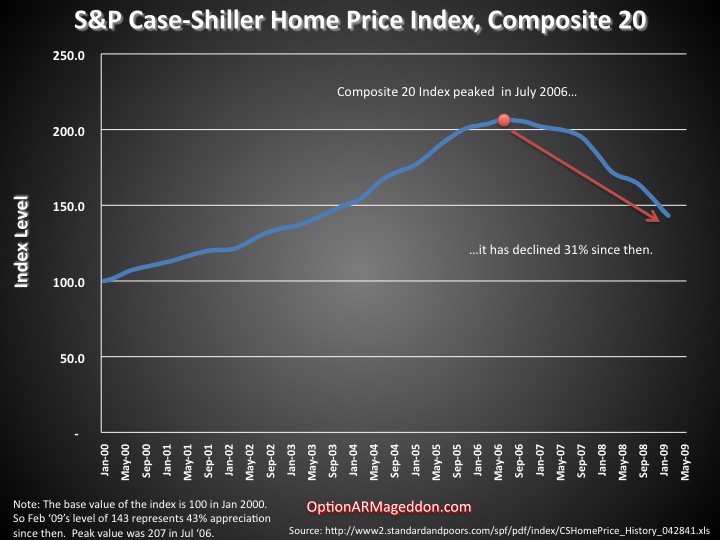
Despite the government’s efforts to put a floor under house prices—printing money to buy MBS in order to hold down interest rates, acting as lender of last resort via Fannie/Freddie/FHA—prices continue to fall. This is bad news for bank balance sheets and existing homeowners, but good news (sort of) for the rest of us who’d like to purchase a home one day at a reasonable cost. Unfortunately, as home prices continue to fall, even renters are put at risk. Everyone who keeps their savings in banks and/or is employed by someone that does, is put at risk as the collateral supporting bank balance sheets continues to deteriorate. Even prime borrowers are defaulting in much greater numbers as house prices fall. This is because negative equity is a better predictor of default than a borrower’s credit rating.
Incidentally, there are those who argue now is the time to buy since interest rates are so low and house prices have declined. I disagree. If you’re planning to live in the house for many years, you have to consider that mortgage rates are likely to increase while you’re still in the house. If incomes don’t increase as well, then the monthly payment an average buyer will be able to afford will stay the same. Same monthly payment + higher interest rates = lower home values.
In other words, with higher rates, the interest component of the monthly payment will be higher. To compensate, house prices will have to fall farther. Higher incomes could support higher house prices, but my feeling is interest rates are likely to head higher before incomes do.
This gets us back to the cheap credit “trap” being set by the Fed. It can’t raise rates, even when the economy returns to “normal.” If it does it will blow a bigger hole in bank balance sheets as the values of interest-rate sensitive assets decline.
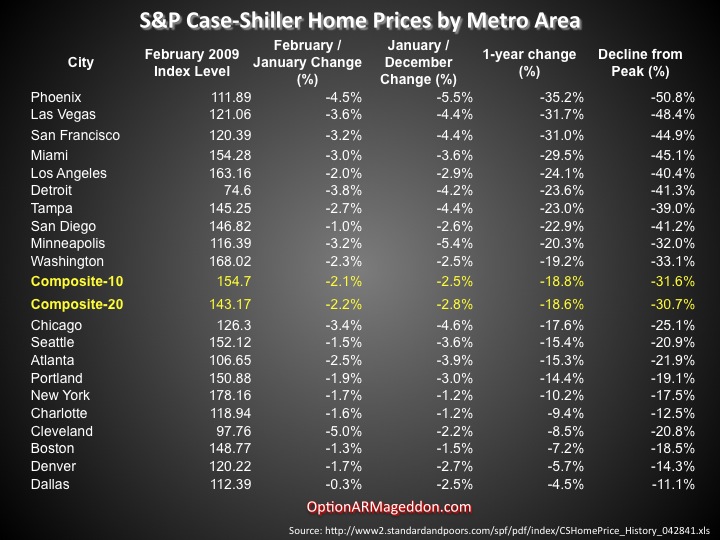
Getting back to the data, I’ve added a column at right that shows the decline from the peak for each metro area. The Comp 20 peak was reached in July 2006, but individual metro areas peaked at different times. Boston, for instance, peaked in September 2005 while Charlotte peaked in August 2007.
Source

No comments:
Post a Comment