I've become numb a long time ago ... but seeing these programs and "solutions" one after the other is simply.... I don't have words. Just enjoy - last week we mentioned how some states had created a work around to use the tax REBATE (i.e. AFTER you buy the home you get the handout) as a substitute for a down payment and closing costs [May 8: Minyanville - Subprime Lending is Back with a Vengeance]
In an effort to boost home buying -- even for marginally qualified borrowers -- a number of states are finding creative ways to advance the tax credit to buyers on the day they get their new keys, rather than having to wait for next year's refund check. This allows buyers to pay for things like closing costs, mortgage points - or even the down payment.
Well folks - it did not take long... the early results of letting people who cannot even find enough money to put 3.5% down into the housing market must of been spectacular. Because in just the blink of an eye this "adjustment" to what Congress originally approved, has now become the federal standard.
(May 12, 2009) Shaun Donovan, secretary of the U.S. Department of Housing and Urban Development, said that the Federal Housing Administration is going to permit its lenders to allow homeowners to use the $8,000 tax credit as a downpayment.
Secretary Donovan said that important changes, which the National Association of Realtors(R) has been calling for, will help consumers purchase a home. "We all want to enable FHA consumers to access the home buyer tax credit funds when they close on their home loans so that the cash can be used as a downpayment," Donovan said.
According to Donovan, the FHA's approved lenders will be permitted to "monetize" the tax credit through short-term bridge loans. This will allow eligible home buyers to access the funds immediately at the closing table.
This is the same FHA we posted last week would cause the next housing bust [May 6: WSJ - FHA Loans, the Next Housing Bust]
Last year banks issued $180 billion of new mortgages insured by the FHA, which means they carry a 100% taxpayer guarantee. Many of these have the same characteristics as subprime loans: low downpayment requirements, high-risk borrowers, and in many cases shady mortgage originators. FHA now insures nearly one of every three new mortgages, up from 2% in 2006.
... taxpayer losses are mounting on its $562 billion portfolio. According to Mortgage Bankers Association data, more than one in eight FHA loans is now delinquent -- nearly triple the rate on conventional, nonsubprime loan portfolios. Another 7.5% of recent FHA loans are in "serious delinquency," which means at least three months overdue.
Because FHA also allows borrowers to finance closing costs and other fees as part of the mortgage, the purchaser's equity can be very close to zero.
So let's wrap this up and put a bow on it. Effectively the US government is going to allow people with "3.5% down" (now covered by the tax payers gift of $8000) to enter into agreements of sub 5% mortgage rates, to FICO scores as low as 620. As long as its your first home. Closing costs? Remembers the FHA allows people to finance that... you don't need to have it on you.
To put that in perspective this means, based on the median home price in America - about 70% of homes are now available to home buyers for less upfront than a rental. In a rental you at least need to save enough to put down a security deposit. Under this innovative program (that was not the original intent of the legislation) $8000 can finance 3.5% down on up to a $228,000 home.
Anyone who can make the monthly payments from there now is welcome to join the home ownership class. Or if you really don't care about your 620, 630 FICO score you can basically get into one of these homes, not make a single payment and live rent free from 12-18 months before they get around to foreclosing on you (which many banks are dragging their feet on).
And if the home value goes down even 1% and you find yourself immediately underwater? You walk away and send the keys to the US taxpayer - we're going to pay for it on the back end as well as the front end.
This is what was done in the auto industry - it's called pulling forward demand with greater and greater incentives (0% interest rates for multiple years, $4K, $5K, $6K rebates). Now we pulled almost all natural demand for home buyers that should of been arriving in 2008-2009 into 2006-2007. So you have to create an even stronger drug when you can rustle up enough home buyers. And here we are.... and when home data "drops at a slower rate than the previous period" we can rally on "2nd derivative improvement"... failing to mention whom is bearing the costs for that improvement.
Am I surprised? No. It's all Groundhog Day at this point - each program begins to sound like the other. Common theme is taxpayer handouts and taxpayers bearing risk - Kick the Can policies. In my predictions piece for 2009 I wrote things would get so desperate... err, correction - I wrote green shoots would be so plentiful that:
But larger than that - my prediction is Fannie/Freddie and then above and beyond that, for people who do not have 20% down and won't pay for insurance, the FHA - will wage a war against current mortgages. We'll see interest rate buydowns, we'll see principal reductions, we'll see anything and everything that basically gives a big (bleep) you to people who have been honoring the system. In return we will tell those people, well if your neighbor's house goes into foreclosure we will all suffer, so it's a necessary evil.
By the back half of 2009, refinancing will reach levels (and above) seen in the bubble years of 2005-2006. Obama & Co will also come up with myriad plans for buyers to suck up excess inventory - the government will be our partner. Nothing should surprise you - this will be an all out assault - we are already seeing the first inane ideas such as no appraisal refinances. The "private" mortgage industry will be almost completely crowded out as no one can compete with what the government will offer.
Source

May 24, 2009
Finding the 'Perfect Time' to Buy a Home
In the kitchen, it's common wisdom that you don't try to catch a falling knife. But in real estate markets that have recently seen double-digit declines, many buyers are anxious to catch the equivalent of a falling house.
 |
AP |
They're betting they can buy property at or near its cyclical bottom by scoping out distressed but fundamentally desirable neighborhoods, floating lowball offers and focusing on bank-owned homes.
It's easy to understand why, given the property values in some of the nation's hardest-hit real estate markets. Home prices in the five worst-performing major metropolitan areas -- Las Vegas, Miami, Phoenix, San Francisco and San Diego -- are down more than 40 percent from their peaks, according to the S&P/Case-Shiller Home Prices Indices. With interest rates for government-backed mortgages at record lows, monthly payments for owner-occupants are at their most affordable levels in years.
Nonetheless, economists and veteran real estate investors say market timing is a risky proposition.
"The odds of you timing the bottom perfectly are pretty low," says Rick Sharga, vice president of marketing at RealtyTrac, a foreclosure data provider. "If you're that good, you should be playing the stock market every day."
Although the current buyer's market may look attractive, rising unemployment rates and persistently high foreclosure rates add pressure on the battered housing sector. Housing Predictor, a forecasting Web site, predicts that 25 housing markets, from Las Vegas to Seattle, will see declines between 14 percent and 27 percent this year.
Sharga sees little reason for prospective owner-occupants in most markets to back away from buying an affordable property. Prices could drop further, he says, but the worst has probably passed. Additionally, historically low mortgage rates and tax incentives for new buyers probably won't last much longer.
Still, real estate is the ultimate local commodity, and some markets will be closer to bottom than others, so prospective buyers looking to protect themselves against further price declines need to consider local economic conditions. Before finalizing a purchase, real estate experts advise that price-sensitive buyers check these five critical factors.
| Mortgages |  |
|
| ||||||||||||||||||||||||||||
| ||||||||||||||||||||||||||||
|


Look for positive indicators: Rising prices are the most obvious indicator of a market recovery, but they’re also evidence that the cycle has already passed its low point. In still-declining markets, however, you can still find other positive indicators. David Kendall, a Realtor in Oakland, Calif., says he's encouraged to see a rise in sales volumes in some hard-hit ZIP codes, indicating that buyers are comfortable with current prices. Other potential turnaround signs include a drop in the number of days that homes sit on the market and an uptick in competitive bidding for compellingly priced properties.
Be aware of "shadow inventory": Banks often don't want to put their entire real estate inventory on the market at once. Doing so can depress prices, particularly in neighborhoods that have not yet seen a high number of foreclosure sales. Because of several factors -- including the recently expired moratorium on home repossessions and anticipation around new federal mortgage assistance programs -- banks have been allowing such "shadow inventory" to build up, says Chris Matty, marketing director at ForeclosurePoint, which publishes foreclosure data. "There's a huge pool of inventory and distressed homes that have not made it to the market yet," he says. "But eventually that has to come."
May 23, 2009
FHA Decision Could Benefit Home Buyers, Builders
The U.S. government gave ailing home builders a ray of hope, although it also raised concerns lending mistakes that fueled the housing boom - and bust - could be repeated.
The Department of Housing and Urban Development's Federal Housing Administration is paving the way for first-time buyers to tap a federal tax credit of up to $8,000 for a downpayment. The announcement, made Tuesday before several thousand real-estate agents attending the National Association of Realtors' Real Estate Summit, could prove a game changer for the sluggish housing ... continue reading
The Department of Housing and Urban Development's Federal Housing Administration is paving the way for first-time buyers to tap a federal tax credit of up to $8,000 for a downpayment. The announcement, made Tuesday before several thousand real-estate agents attending the National Association of Realtors' Real Estate Summit, could prove a game changer for the sluggish housing ... continue reading
May 22, 2009
Is buying a home with a friend a good idea?

What do you do if you want to buy a house but can't afford it? Ever thought about buying a home with a friend?
More and more, friends are teaming up to do just that. Time Magazine recently dubbed the term 'Co-Ho,' for communal homeowners.
While it can save you money and help build equity, there are some pitfalls. But a couple of friends who partnered up to purchase a home together say if you do it right, it can work.
Good friends Jaime Arb-Haessig and Sarah Marzolf share a duplex in northeast Portland and by 'sharing,' we mean the loan, the taxes, the maintenance and the utility bills. Both are in their early 30s and figured they would pool their money to give them greater buying power.
"I work at a non-profit, so I would not be able to afford to buy a house by myself," said Marzolf.
"When I was looking to buy a home, I realized I couldn't buy into a neighborhood I wanted to live in," said Arb-Haessig.
But owning a home together meant having their finances and assets tied together and the bank doesn't care who is late with the check. If one person defaults on the loan, both their credit ratings could take a hit. The thought of that didn't sit well with their families at first.
"Hell no was my parents' reaction," said Marzolf. "They're like 'that's not a good idea, you don't know what's going to happen.' "
But the contract was very specific and included everything from how long they plan to keep the property, how it will be sold, how to handle repairs, what happens if one moves out, what happens when one of them dies and even naming a third-party mediator in case something turns ugly.
The two don't anticipate anything going wrong and said their living arrangement has actually helped their friendship.
"We've stayed closer than we would have otherwise," said Arb-Haessig. "And we're more up on what's going on in each other's lives."
They also have other contingencies in place. They opened a joint rainy day account for emergency repairs or if someone is a little late on a payment one month. Arb-Haessig also recommends consulting a real estate attorney.
Source
May 21, 2009
Not-So-Tricky Split: The Home Buyer Tax Credit
The new-and-improved version of the First-Time Homebuyer Credit offers rookie home buyers (or those who simply haven't owned a home in the past three years) a chance to get a federal income tax credit of up to $8,000. Thanks to this year’s Stimulus Act, you don't have to repay the credit like you did with last year’s version.
Even better, the IRS says unmarried individuals can team up on a home purchase and then share the credit. If you're thinking of going this route, here's what you need to know to get the best tax-saving results:
How Much You'll Get
The updated First-Time Homebuyer Credit can be applied to purchases of homes that occur between Jan. 1, 2009, and Nov. 30, 2009. The maximum credit equals the lesser of 10% of the purchase price of a principal residence or $8,000. Or, in the case of married individuals who file separately, $4,000. (These amounts are up from the $7,500 and $3,750 limits for purchases that occurred between April 9 and Dec. 31 of last year.)
There are some catches, however. The credit is phased out (reduced or completely eliminated) if your modified adjusted gross income (MAGI) is too high. (For this purpose, MAGI means the adjusted gross income figure reported on the last line on page 1 of your Form 1040 increased by certain income from outside the U.S. that is exempt from taxation.)
For married joint filers, the credit is phased out when the MAGI is between $150,000 and $170,000. For unmarried individuals and married individuals who file separately, the credit is phased out between MAGI of $75,000 and $95,000.
You can use the credit to offset your entire federal income tax bill, including any alternative minimum tax (AMT). Since the credit is refundable, you can collect any amount left over after your tax bill has been reduced to zero in cold, hard cash.
Eligibility
The credit is only available to buyers who have not owned a principal residence in the U.S. during the three-year period that ends on the purchase date for the home. That home must serve as the new principal residence.
If you’re married, both you and your spouse must pass the three-year test (whether or not you file jointly). If you’re unmarried, and you team up with another person to buy a home that serves as the new principal residence for you both and you both pass the three-year test, then you can share the credit. If only one of you passes the three-year test, only that person can claim the credit.
Unmarried Buyers Can Share the Credit
Say two (or more) unmarried individuals buy a home together that serves as their new principal residence. Assuming each person passes the three-year test and they jointly own the property as tenants in common or as joint tenants, they can pretty much share the credit any way they choose, according to IRS Notice 2009-12. However, the total credit is still limited to the lesser of 10% of the purchase price or $8,000. And the credit allocated to each person is still subject to the phase-out rule, based on MAGI. Although the IRS doesn’t actually say so, it appears you can’t claim a credit that exceeds your share of the purchase price (including your share of any mortgage debt). Here’s an example to illustrate the possibilities.
Example: Say you and your significant other jointly buy a home for $150,000 in June of this year and you both pass the three-year test. You pay 60% of the cost, and your partner pays 40%. The available credit for this purchase is $8,000 (lesser of 10% of the purchase price or the $8,000 credit ceiling). You and the other person could agree to share the credit 60/40 to reflect your shares of the purchase price. But if the other person's MAGI is too high to claim the credit and yours is not, then it makes good tax-saving sense to have the entire $8,000 allocated to you. On the flip side, if your MAGI is too high, the entire $8,000 could be allocated to the other person. Or you could split the credit 50/50, or 75/25, or 25/75, or whatever allocation suits the two of you best. Anything you decide is OK with IRS.
Word of Caution: Credit Must Be Repaid in Some Circumstances
Under last year’s version of the First-Time Home Buyer Credit, those who bought homes between April 9, 2008, and Dec. 31, 2008, were generally required to repay the credit over 15 years. The Stimulus Act eliminated the repayment rule -- in most cases. However, the repayment rule can still hit you if you sell the home you buy in 2009 within three years of the purchase date or stop using the home as your principal residence during that time. If either of those events occurs, you generally must repay your entire credit when you file your Form 1040 for the year during which the triggering event occurs (no 15-year repayment deal for you
Source
May 11, 2009
ARMed and underwater Refinancing is still possible under president's program
Question: I have a problem. Like most people out there, my mortgage is underwater. However, I have a double negative in that I bought my home in late June 2005 with an adjustable-rate mortgage with the idea of refinancing after three years.
Now, the economy has taken a plunge, along with the value of my home, which I purchased for $129,000 and is now worth $110,00-$115,000. My lender will allow borrowers such as me to refi only twice. I have gone that route once before, and I'm afraid to go there again because if I refi too early, I won't be able to do it again. My payments are $1,186 a month on a 8.625% interest rate and that hurts!
I live in a low-income area. I have spoken to another bank, which tells me my wife and I are qualified for an FHA loan. Both of us have good jobs and make enough money to cover the mortgage. But we feel its time to switch to a fixed-rate loan. So far, no lender has been able to help us.
Answer: You seem to be an excellent candidate for President Obama's Making Home Affordable program. But before you go there, I'd say that if your current lender is willing to refinance you out of an ARM into a fixed-rate mortgage, go for it. I doubt rates are going to fall much more than they already have, so I wouldn't be afraid to pull the trigger a second time because it's "too early."
A Santa Barbara wildfire forces thousands to evacuate their homes and California Gov. Arnold Schwarzenegger declares a state of emergency. Video courtesy of Fox News.
There is nothing wrong with grabbing a rate in the 5% range right now, especially if it gives you payments you can afford. My gosh, that's better than a 3.5 point difference. So in your case, the second time could be a charm.
If you are not successful, check out www.makinghomeaffordable.gov, which outlines the administration's plan to help stabilize the housing market by reducing the mortgage payments of up to 9 million eligible homeowners.
The refinance portion of the effort gives up to 5 million owners with loans owned or guaranteed by either Fannie Mae or Freddie Mac an opportunity to trade in their loans for ones that are easier on their pocketbooks. And the loan modification part commits $75 billion to keep as many as 4 million other families in their homes by preventing avoidable foreclosure.
The Web site has detailed information about these programs along with self-assessment tools and calculators to empower borrowers with the resources they need to determine whether they might be eligible for a modification or a refinance under the program. Check out the Making Home Affordable site.
Borrowers also can use the site to connect to free counseling resources to answer any questions they may have about their own personal situations. You'll also find a checklist of key documents and materials to have ready when making that important call to your lender as well as FAQs from borrowers in similar circumstances.
Q: I enjoyed your article on tax credits for energy efficient home improvements. The question I have is, do the credits phase out at higher income levels like so many of the recent tax rebates and credits (typically over $75,000).
A: Good news. There are no income limitations on the energy credits. So feel free to spend away.
Q: Great article on reverse mortgage for seniors who want to scale down the housing ladder. What happens to the lower property tax basis on the first house, the one in California? Who pays the property tax bill, and could they have used the lower or carryover basis of the old property tax basis since they over 55? See previous Realty Q&A.
A: I'm an East Coast guy who doesn't know all that much about the Left Coast. So I turned your question over to Robert D. Yeary, CEO of Reverse Mortgage Solutions. The Spring, Tex., firm has developed a specialized, state of the art system to service reverse mortgages in all jurisdictions. Here's his response:
"In California, you can transfer your old tax base to a new house, provided the county in which you purchase your new home allows that transfer. Not all counties do that. But even in jurisdictions that do allow a transfer, if you pay more for the new house, you can only transfer the tax base if the purchase price is no greater than 105% of the amount for which you sold your previous residence. If you wait a full year after the sale of your home, you can transfer 110% of the selling price."
If the new house is considerably less expensive that the home you sold, Yeary suggests considering what the property tax would be without transferring the lower basis to the new place.
"Surprisingly," he says, "in California, real estate taxes are fairly low thanks to Proposition 13. Taxes are set at the time you purchase the home and can go up only so much every year. There are plenty of houses worth $500,000 or more in California with low tax bases because they were purchased years ago for $35,000."
Yeary also notes that the Golden State offers several tax relief program for low and moderate-income seniors.
Source
May 10, 2009
Where can working Americans afford a home?
They are still priced out of the housing market in many cities across the country, a new study concludes.
Housing prices may have plummeted, but they’re still not affordable for many working men and women in America.
The National Housing Conference Thursday released its annual “Paycheck to Paycheck” report, which compares workers salaries and home prices in more than 200 communities across the country.
The bursting of the real estate bubble has made owning a home more affordable for some, with the median price of a home dropping 14.5 percent nationally in the past year, the report concluded. But the majority of essential workers like teachers, police, and firefighters still cannot afford to buy a home in the towns and cities where they work, it added.
The “Paycheck to Paycheck” report takes an in-depth look at construction-related jobs, which are expected to get a boost from the Obama administration’s stimulus package. It analyzed five jobs: construction managers, carpenters, equipment operators, long-haul truck drivers, and construction laborers. It concluded that only construction managers, who make about $100,000 a year, can afford to buy a home in the 208 housing markets analyzed.
Carpenters were able to afford to own a home in 51 of the 208 studied markets, and equipment operators in 35 markets. Construction laborers were priced out of 196 of the communities.
“Just because prices are falling, that doesn’t mean that we have seen an end to the problem of affordability, because for many people, particularly at the low end of the income spectrum, people are losing their jobs or their hours are being cut back,” says Nicolas Retsinas, director of Harvard’s Joint Center on Housing Studies.
“So it’s not just the cost of housing, whether to purchase or rent, but it is also people’s ability to pay,” he adds. “And in this economic situation we’re in, that’s becoming much more problematic.”
San Francisco remains the most expensive city in which to buy a home, with a median price of $575,000, according to the report. That’s down from $770,000 a year ago. New York ranks second with a median price of $455,000, a drop of $70,000 from a year ago. The least expensive places are Saginaw, Mich., and Youngstown, Ohio, each with a median home price of $73,000.
That price is affordable for most working Americans. But there’s a catch. “The problem in a lot of these more-affordable areas is that unemployment is a substantial problem, so being able to actually purchase a home still may not be in everyone’s cards,” says Maya Brennan, a researcher at the Center for Housing Policy, the research arm of the National Housing Conference.
The report also found that rents rose nationally by 3.7 percent in the past year. But in Florida, which has been hit hard by the foreclosure crisis, rents spiked more significantly.
“One hypothesis is that as people are losing their homes, they become renters. And in the past renters could easily become homeowners, but now that door is shut to many,” says Professor Retsinas. “So in some markets, you see an increase in demand for rental housing, and an increase in demand for anything has a tendency to raise prices.”
The data have prompted calls for federal, state, and local officials to create more affordable housing, particularly in high-priced urban areas. The Department of Housing and Urban Development already has a Neighborhood Stabilization Program, which is designed to rehabilitate abandoned foreclosed homes, a certain amount of which must be affordable. But housing experts say that much more needs to be done.
“Although home prices have dropped, states and localities and the nation as a whole still have to pay attention to the needs of low- and moderate-income workers,” says Ms. Brennan. “A lot of communities can take advantage of the lower home prices to try to buy some properties themselves and get them preserved as affordable housing for the future.”
Some housing policy experts like Retinas see the housing market crisis as an opportunity.
“There’s an irony that in the midst of this calamity in the housing market, there’s a reaffirmation of the adage that housing really matters,” he says. “It was very difficult in years gone by to put affordable housing on the agenda, because people considered it an afterthought. Now have learned full well what happens when people lose their homes and are unable to afford a place to live.”
Source
May 9, 2009
First 100 days of Obama: Stimulus plan includes tax breaks for many people
Whether the multibillion-dollar economic stimulus plan will actually jump-start the nation's ailing economy is uncertain.
But one thing is for sure: The plan has real perks for many American families -- some worth hundreds of dollars, some worth thousands. Of course, some families will benefit little, if at all.
For more information on the incentives, go to www.irs.gov and click on "Update on Recovery Tax Provisions for Individuals and Businesses."
Break for home buyers » Buy a home before Dec. 1 and you could get as much as $8,000.
The money is a tax credit that does not have to be repaid if the home remains your primary residence for at least three years. Although it is touted as an incentive for first-time buyers, those who have owned homes in the past may qualify, as well.
The IRS defines a first-time buyer as someone who has not owned a home in the three years prior to the date he or she closes on a home this year.
The free money is available only to those who have purchased after Jan. 1. Buyers who purchased between April 8 and Dec. 31, 2008, are eligible for an incentive worth as much as $7,500, but that must be repaid.
The credit is reduced or eliminated for higher-income taxpayers. It begins to be phased out for single filers with modified adjusted gross incomes of more than $75,000. Those earning more than $95,000 don't qualify.
Advertisement
For married couples filing jointly, the credit begins to be phased out at incomes of more than $150,000; those earning more than $170,000 don't qualify.
Incentive for car buyers » Purchase a new car, light truck, motor home or motorcycle and you may be entitled to deduct the taxes you paid on next year's tax return.
Taxes on up to $49,500 of the purchase price may be deducted if you bought after Feb. 16 and before Jan. 1, 2010.
Unlike the homebuyer tax credit, which reduces your tax liability dollar for dollar, this deduction simply reduces your taxable income. So, its value depends on your tax bracket.
The amount of this deduction also is phased out for higher-income taxpayers. Don't itemize? That doesn't matter -- you can still take this deduction.
In addition to the $8,000 federal incentive, Utah is offering $6,000 grants to homebuyers. Unlike the federal money, the state incentive is available only for those who buy new homes, and it's limited to the first 1,600 home buyers. About 1,100 grants are still available. For information, go to www.utahhousingcorp.org.
More money in worker paychecks » Most taxpayers qualify for a tax credit of up to $400 this year and next -- $800 for married couples filing jointly.
But taxpayers won't have to wait until they file their returns before they get their money. This benefit is being coordinated with employers, who are delivering the incentive by withholding less money from paychecks -- to the tune of about $45 to $65 more per month for some people.
The credit, based on 6.2 percent of earned income, phases out for higher-income taxpayers.
To compensate for the reduced amount being withheld, employees will take a tax credit when filing 2009 and 2010 returns. So, even though less money is being taken out of paychecks, employees won't owe more in taxes or get less of a refund.
More benefits for the unemployed » Weekly unemployment benefits have been increased by $25 per week, and workers who exhaust 26 weeks of unemployment benefits may be eligible for 20 additional weeks.
Even better, the first $2,400 of unemployment benefits a person receives in 2009 is tax free. Additionally, many laid-off workers are eligible for a new 65 percent subsidy that helps cover much of the high cost of continuing health insurance coverage under the federal COBRA program.
The subsidy is available for up to nine months. You must have been laid off between Sept. 1, 2008, and Dec. 31 of this year to qualify. For information, call your former employer's human resources department or contact the Utah Department of Insurance at www.insurance.utah.gov or by calling (801) 538-3077.
Source
May 8, 2009
First-time homebuyer? Take advantage of this tax benefit
Under two recent pieces of federal legislation, a first-time homebuyer may be able to take advantage of a tax benefit when purchasing a home.
Note that a "first time home buyer" includes those who have not owned a home in the three years prior to a current purchase, but may have owned a home prior to those three years.
For married taxpayers, the law tests the homeownership history of both the home buyer and his/her spouse. But there are two different types of credits: one for those who purchased a home between April 9, 2008, and Dec. 31, 2008, who may be eligible for a federal tax credit of up to $7,500, and another for first-time buyers who purchase a home between Jan. 1, 2009, and before Dec. 1, 2009, who may be eligible for a federal tax credit of up to $8,000.
In either case, the credit is equal to 10 percent of the purchase price of a principal residence, up to $7,500 or $8,000.
There are, however, differing effects to the two credits. Unlike other types of tax credits, the first-time homebuyer credit for 2008 must be repaid over 15 years. Furthermore, it will need to be repaid in full if the taxpayer sells the house within the 16-year repayment period.
Some have described the credit as an "interest-free loan" because of this repayment requirement.
In contrast, the 2009 tax credit does not have to be repaid, but home buyers must use the residence as a principal residence for at least three years, or face recapture of the tax credit amount.
The credit is phased out, or reduced, for individuals with modified adjusted gross income between $75,000 and $95,000. For married couples filing a joint return, the phase out range is $150,000 to $170,000.
The tax credit amount is reduced to zero for taxpayers with adjusted gross income of more than $95,000 (single) or $170,000 (married), and is reduced proportionally for taxpayers with adjusted gross income between these amounts.
To determine modified adjusted gross income, it is necessary to add certain sums, such as foreign income, foreign-housing deductions, student-loan deductions, IRA contribution deductions and deductions for higher-education costs.
Interestingly, the credit is fully refundable, meaning taxpayers will be able to obtain an additional federal tax refund of up to $7,500 or $8,000, even if they have no other tax liabilities or if the credit is more than the tax that they owe. Typically this involves the government sending the taxpayer a check for a portion, or even all, of the amount of the refundable tax credit.
For a home that a taxpayer builds, the purchase date is the first date of occupancy of the home. For a pre-existing home, the purchase date is the date when closing occurs and the title to the property transfers to the home owner.
A primary residence is a residence in which an individual lives most of the time and can be a house, condominium, or even mobile home. The definition of principal residence is identical to the one used to determine whether you may qualify for the $250,000-$500,000 capital gain tax exclusion for principal residences.
People who purchased a home between April 9, 2008, and Dec. 31, 2008, (the $7,500 credit) should claim the credit on their 2008 tax returns, and may need to amend the return if one has already been filed. The credit must be repaid in 15 equal installments over 15 years, beginning with the 2010 tax year.
People who purchased a home between Jan. 1, 2009, and before Dec. 1, 2009, (the $8,000 credit), can claim the credit on their 2008 or 2009 tax returns (if the 2008 return is already filed, the taxpayer will need to amend that return to treat the purchase as occurring on Dec. 31, 2008).
Taxpayers using the 2009 credit do not have to repay it provided the home remains their main residence for 36 months after the purchase date.
Given the complexities with the differing credits, and the fact that an amended tax return may need to be filed, readers are urged to consult with their financial, tax and legal professionals to assist in claiming the refund.
Source
May 7, 2009
New tax credit available for homebuyers
Missouri is offering a unique addition to a federal tax credit program intended to bring the country's housing market out of the doldrums by offering credits to first-time homebuyers.
The program, which is part of the $787 billion federal stimulus package passed in February, increases the amount that first-time homebuyers can receive from the program from $7,500 to $8,000. The original amount was set in stimulus package passed in November 2008.
The Missouri Housing and Development Commission is offering a variation of the program that no other U.S. state is practicing. The commission is offering to preemptively loan homebuyers the money for the federal tax credit before the federal government distributes the credit. The homebuyer then turns federal credit over to the state commission, and must keep the same address for three years. The homebuyer must also pay back the loan before June 2010 to avoid interest charges.
Without this variation, homebuyers in Missouri would first have to purchase a home, and then would receive their tax credit after they filed their income taxes for the following tax season.
U.S. Sen. Claire McCaskill, D-Mo., was in Columbia on Saturday for a news conference to discuss the program. The conference was held at the home of Travis and Jessica Peterson, two longtime Columbia residents who just purchased a home on the east side of the city and soon thereafter received $8,000 from the program.
In a news release issued prior to her appearance, McCaskill said the tax credit program would help to recover the economy.
"Buying a first home is an integral part of the American dream and the economic recovery package gives first-time homebuyers a tremendous incentive and help in realizing that dream," McCaskill said in the release.
The Petersons, who had already purchased the house but received the credit, said they were going to use the money to build a privacy fence around the backyard of the house.
Jessica Peterson said the fence would be useful because the couple is expecting a child in October.
"We're very happy he could do this," Peterson said.
Columbia Board of Realtors President Carol Van Gorp said since the beginning of March, 14 percent of homes sold in Columbia used the tax credit.
Van Gorp said the credit could be useful for college-aged homebuyers that seek to leave rental properties. She said it was not uncommon for the parents of students to buy houses in the names of their children so that they can cash in on the credit.
Van Gorp said the program would help stimulate the economy, not only by moving sluggish housing sales, but also through the purchase of consumer goods and the collection of sales tax.
"We need housing to recover so that the economy can recover," Van Gorp said.
According to data released by the Kaiser Family Foundation, the rate of foreclosures in Missouri was lower than the national average. According to the National Association of Home Builders, there was an increase in new home sales in the U.S. in March, up almost 20,000 new homes from 331,000 sold in January. In March 2008, though, 513,000 homes were sold in the U.S.
Andi Benson, a spokeswoman for the Missouri Housing and Development Commission, said 97 home sales have closed using the credit, and an additional 257 are being processed. She said 47 of the cleared sales went to owners in their 20s.
Benson said the loan was intended to help first time homebuyers pay their down payments and closing costs.
"Most of us don't have that kind of money laying around," Benson said.
Source
May 6, 2009
Home Prices Still Dropping - Just Not as Fast
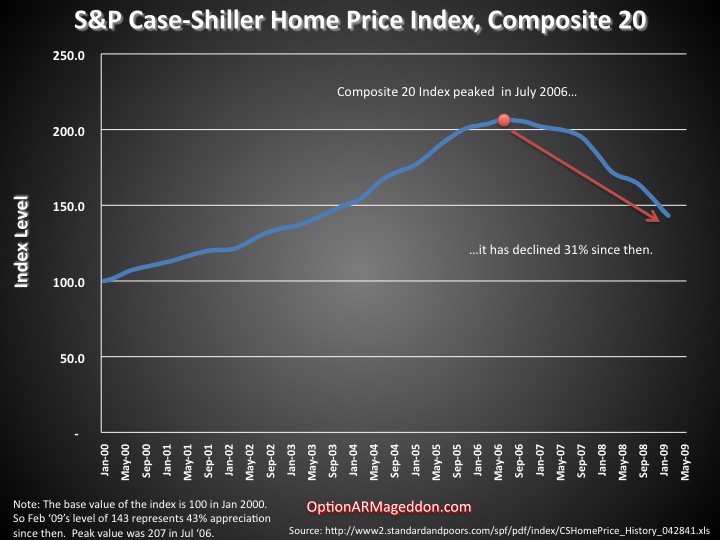
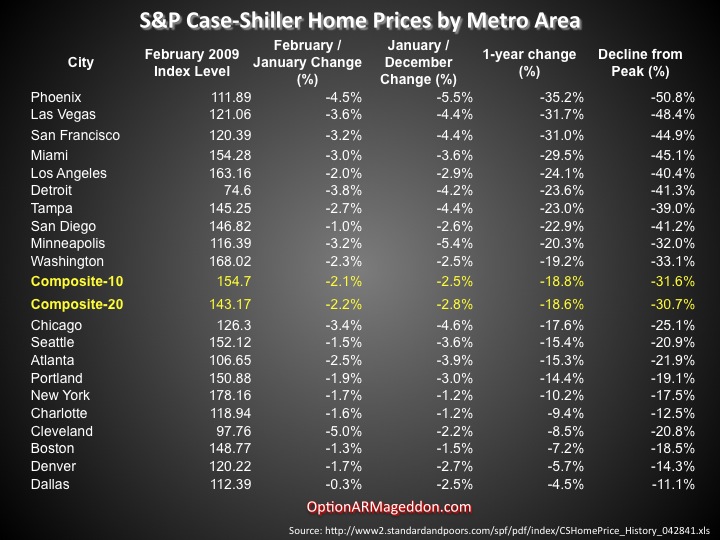
February Data for the S&P Case-Shiller Index was released today. Prices are still falling, and quickly. Each of the 20 major metro areas measured by the index showed another a month-over-month decline, for the fifth month in a row. The Composite 20 Index is now off 31% from its peak, reached in July 2006. It fell another 2.2% from January to February. 15 of the 20 metro areas showed a greater than 10% fall in prices versus last year and one city, Phoenix, has now fallen over 50% from its peak. (More detail by metro area in the table below.)

Despite the government’s efforts to put a floor under house prices—printing money to buy MBS in order to hold down interest rates, acting as lender of last resort via Fannie/Freddie/FHA—prices continue to fall. This is bad news for bank balance sheets and existing homeowners, but good news (sort of) for the rest of us who’d like to purchase a home one day at a reasonable cost. Unfortunately, as home prices continue to fall, even renters are put at risk. Everyone who keeps their savings in banks and/or is employed by someone that does, is put at risk as the collateral supporting bank balance sheets continues to deteriorate. Even prime borrowers are defaulting in much greater numbers as house prices fall. This is because negative equity is a better predictor of default than a borrower’s credit rating.
Incidentally, there are those who argue now is the time to buy since interest rates are so low and house prices have declined. I disagree. If you’re planning to live in the house for many years, you have to consider that mortgage rates are likely to increase while you’re still in the house. If incomes don’t increase as well, then the monthly payment an average buyer will be able to afford will stay the same. Same monthly payment + higher interest rates = lower home values.

In other words, with higher rates, the interest component of the monthly payment will be higher. To compensate, house prices will have to fall farther. Higher incomes could support higher house prices, but my feeling is interest rates are likely to head higher before incomes do.
This gets us back to the cheap credit “trap” being set by the Fed. It can’t raise rates, even when the economy returns to “normal.” If it does it will blow a bigger hole in bank balance sheets as the values of interest-rate sensitive assets decline.
Getting back to the data, I’ve added a column at right that shows the decline from the peak for each metro area. The Comp 20 peak was reached in July 2006, but individual metro areas peaked at different times. Boston, for instance, peaked in September 2005 while Charlotte peaked in August 2007.
Source
Despite the government’s efforts to put a floor under house prices—printing money to buy MBS in order to hold down interest rates, acting as lender of last resort via Fannie/Freddie/FHA—prices continue to fall. This is bad news for bank balance sheets and existing homeowners, but good news (sort of) for the rest of us who’d like to purchase a home one day at a reasonable cost. Unfortunately, as home prices continue to fall, even renters are put at risk. Everyone who keeps their savings in banks and/or is employed by someone that does, is put at risk as the collateral supporting bank balance sheets continues to deteriorate. Even prime borrowers are defaulting in much greater numbers as house prices fall. This is because negative equity is a better predictor of default than a borrower’s credit rating.
Incidentally, there are those who argue now is the time to buy since interest rates are so low and house prices have declined. I disagree. If you’re planning to live in the house for many years, you have to consider that mortgage rates are likely to increase while you’re still in the house. If incomes don’t increase as well, then the monthly payment an average buyer will be able to afford will stay the same. Same monthly payment + higher interest rates = lower home values.
In other words, with higher rates, the interest component of the monthly payment will be higher. To compensate, house prices will have to fall farther. Higher incomes could support higher house prices, but my feeling is interest rates are likely to head higher before incomes do.
This gets us back to the cheap credit “trap” being set by the Fed. It can’t raise rates, even when the economy returns to “normal.” If it does it will blow a bigger hole in bank balance sheets as the values of interest-rate sensitive assets decline.
Getting back to the data, I’ve added a column at right that shows the decline from the peak for each metro area. The Comp 20 peak was reached in July 2006, but individual metro areas peaked at different times. Boston, for instance, peaked in September 2005 while Charlotte peaked in August 2007.
Source
April 30, 2009
Mortgages Falling to 4% Become Bernanke Housing Focus

Grace and John Pitts got a 4 percent interest rate on a 30-year fixed mortgage when they bought their Cape Cod-style home in Quincy, Massachusetts, in 1951.
That was about the lowest rate anybody got in the next 60 years.
Those days may be returning as history provides Federal Reserve Chairman Ben S. Bernanke lessons on how to rescue the U.S. from the housing slump. Home loans may go as low as 4 percent if the economy worsens, said Robert Edelstein, a professor at the Haas School of Business at the University of California, Berkeley. Record foreclosures, falling home prices and an economy that has lost 5.1 million jobs since December 2007 will pressure Bernanke to further reduce borrowing costs.
“The Fed will have to do whatever it takes,” Edelstein said. “People will buy cheaper houses at very low interest rates.”
Conventional mortgages averaged 4.61 percent in 1951, 4 percent when backed by the Veterans Administration, and 4.25 percent by the Federal Housing Administration, according to “The Postwar Residential Mortgage Market,” a 1961 book written by Saul Klaman and published by Princeton University Press. Rates during the 1930s were as high as 7 percent.
Bernanke, a Harvard-educated student of the Great Depression who spent his 20-year academic career writing and teaching about the 1930s, is using his knowledge of that era to avoid the missteps policy makers made then. He’s bringing down mortgage rates, supporting the banking system, and buying back government debt and mortgage-backed securities to relieve the scarcity of credit.
Gold Standard
“In the Depression, the Fed was very, very slow to react,” said Mark Gertler, a New York University economist and co-author of at least nine papers with Bernanke. “He was determined to not have the central bank stand by.”
The Fed was focused on backing the gold standard during the 1930s and it didn’t take a “bigger picture perspective” because the economy was more regional then, said Robert Eisenbeis, chief monetary economist for Vineland, New Jersey- based Cumberland Advisors Inc., and former research director at the Federal Reserve Bank of Atlanta.
“There really wasn’t a coordinated group sitting in Washington deciding what monetary policy was,” Eisenbeis said of the Depression-era Fed. “There weren’t people setting policy in the sense that we think of it now.”
Depression Rates
Bernanke, 55, pointed to that weakness in a 2004 speech at Washington and Lee University in Lexington, Virginia.
“By allowing persistent declines in the money supply and in the price level, the Federal Reserve of the late 1920s and 1930s greatly destabilized the U.S. economy and, through the workings of the gold standard, the economies of many other nations as well,” Bernanke said.
The Fed tightened credit at the start of the Great Depression. Average mortgage rates from savings and loans in the 1930s ranged from 6 percent to 7 percent, according to “Urban Mortgage Lending: Comparative Markets and Experience,” a 1956 book by J.E. Morton that drew on data from the National Bureau of Economic Research.
“To the extent that the home mortgage market did function in the years immediately following 1933, it was largely due to the direct involvement of the federal government,” Bernanke wrote in a 1983 paper when he was an associate professor of economics at Stanford University’s Graduate School of Business in Stanford, California.
Mortgages of 1940s
Mortgages were cheaper through most of the 1940s, ranging from about 4 percent to 5.7 percent, depending on whether the lender was a life insurer, a commercial bank or a savings and loan. In that era, most loans were for 14 years and less.
During the five-year U.S. housing boom that ended in 2005, mortgage rates averaged 6.21 percent. As Bernanke pushed the Fed to ease credit, the average has dropped to 5.02 percent this year.
The central bank has purchased more than $300 billion of mortgage-backed securities in 2009 through the week ended April 8, helping to cut home-loan rates to 4.82 percent last week from 5.1 percent at the start of the year, according to Freddie Mac data. The rate was 4.78 percent in the week ended April 2, the lowest since Freddie Mac started keeping records in 1971.
In a sign that banks were more willing to lend, the London interbank offered rate, or Libor, for three-month dollar loans dropped to 1.12 percent on April 14 from 1.32 percent a month ago. It was as high as 4.82 percent on Oct. 10.
‘Under Stress’
The difference between 30-year mortgage rates and 10-year Treasury yields has narrowed to about 2.2 percent from 3.1 percent in December, which was the widest since 1986. The spread remains almost 0.7 percentage point above the average of the past decade, data compiled by Bloomberg show. Rates for 15-year mortgages are about 1.8 percent above 10-year Treasury yields, compared with an average 1.4 percent since 1999.
In 1931, the disparity between Treasury bonds and the average rate for a mortgage was 3.26 percentage points.
When Bernanke “saw credit spreads increasing at various times over the crisis, that was a sign to him, as happened in the Great Depression, that the markets were under stress,” said Gertler of New York University.
Cut to Zero
The spread between average mortgage rates and the Fed’s discount rate was about 1 percent at the start of the Depression. In January 1930, the Federal Reserve Bank of New York’s discount rate was 4.5 percent. It fell to 1.5 percent by February 1934 and to 1 percent by August 1937, according to a Fed publication of banking and monetary statistics from 1914 to 1941 on the Web site for the Federal Reserve Bank of St. Louis.
The Fed, led by Bernanke, cut the rate to as low as zero four months ago for the first time.
Bernanke, the first Fed chairman born after the 1929 stock market crash, was appointed head of the central bank in 2006.
“I’m a Great Depression buff the way some people are Civil War buffs, and it’s because the issues raised by the Great Depression and its lessons are still relevant today,” Bernanke said in the introduction to a school curriculum on the 1930s financial crisis designed by the St. Louis Fed.
Job Losses
Lower rates alone may not help Bernanke or the housing market. Fed Bank of Dallas President Richard Fisher said April 14 the jobless rate may exceed 10 percent this year, crimping chances of a recovery. The unemployment rate was 8.5 percent at the end of March, data compiled by the Labor Department show.
“It’s going to be a long grind,” said Dan Gertner, an analyst at New York-based Grant’s Interest Rate Observer who estimated the 30-year rate may drop to 4.5 percent. “Bernanke has a very difficult task in front of him, and I’m not sure if simply lowering mortgage rates from 4.8 percent to 4.5 percent to 4.25 percent will increase the number of people who want to buy houses.”
The two-year recession has cut consumer confidence and pushed the jobless rate to the highest level since 1983. The number of people who said they plan to buy a home in the next six months fell to a 26-year low in March, according to a Conference Board survey released on March 31.
Economists at San Francisco-based Wells Fargo & Co., the second-biggest U.S. bank by market value, doubt rates will fall to that level. They forecast 30-year mortgages may decline to 4.67 percent in June before rising the rest of the year as the yield on the 10-year Treasury yield increases.
Long-term mortgage rates falling to 4 percent would help boost the housing market, said Scott Anderson, senior economist at Wells Fargo in Minneapolis.
‘Solid Floor’
That would “put a solid floor under home sales and starts, and allow activity to really pick up,” Anderson said. “You could see home prices bottom out sooner.”
“The initial shock of the policy moves seems to have faded,” said Donald Rissmiller, chief economist at Strategas Research Partners in New York. “The further you see rates rise the more they’re going to be interested in countering that.”
Jay Brinkmann, chief economist for the Mortgage Bankers Association, agrees rates may not go much lower.
“We expect an average at about 4.8 or 4.9 percent for the balance of the year,” said Brinkmann. Late this year or early next year, borrowing costs may rise, he said.
1950s Boom
When Grace and John Pitts bought their home in 1951 for $8,500, most people got mortgages from their local savings and loan, said Dave Mason, an assistant professor at Georgia Gwinnett College in Lawrenceville, Georgia, who also Wrote “From Buildings and Loans to Bail-Outs, A History of the American Savings and Loan Industry, 1831-1995.”
The low borrowing costs and unemployment that followed World War II sparked a housing boom that pushed home ownership to 62 percent by 1960 from 44 percent in 1940, data compiled by the Census Bureau show.
The frenetic building pace of the 1950s was driven by veterans taking advantage of the GI Bill’s VA-insured loans. There were 1.26 million VA-guaranteed first mortgages in 1950 and 1.33 million FHA-insured first mortgages, the Census Bureau reported.
The most famous suburb was Levittown, developed by William Levitt on a former tract of farmland about 30 miles east of New York City. The community had more than 17,000 homes built on 60- foot-by-100-foot lots and each cost about $6,990. The project landed Levitt on Time magazine’s cover in July 1950.
Levittown Project
World War II veteran Frederick Johs, 86, bought his first home in 1954, a Cape Cod-style, gray two-bedroom house in Levittown. Johs, a former Army corpsman in France and England, got a VA-insured 30-year mortgage at 2 percent. He paid $8,400 for the house, including a $1,000 down payment, and his monthly mortgage was $60.
“I thought it was a good deal at the time only because we were capable of paying that mortgage,” Johs said. “Today, it’s rough. I feel for the people today.”
Now with prices declining and the domestic economy in the worst recession since 1982, buyers are on the sidelines. Home prices have declined 28 percent since 2006, the Chicago-based National Association of Realtors reported.
Freddie Mac, the McLean, Virginia-based mortgage buyer, forecast last week total U.S. home sales will decline 4.4 percent in 2009 to 4.61 million. House prices may fall another 10 percent before bottoming next year, said Mark Kiesel, global head of Pacific Investment Management Co.’s corporate bond fund management group in Newport Beach, California.
Fannie Forecast
Fannie Mae, the Washington-based mortgage buyer, said last month that prices may drop by 9.4 percent in the second quarter from a year ago and decline by another 8.7 percent in the third quarter.
“Home sales won’t rebound significantly until the job market stabilizes in early 2010,” Mark Zandi, chief economist at Moody’s Economy.com in West Chester, Pennsylvania, said in an e-mail. Zandi forecasts the 30-year rate will fall to about 4.5 percent by June. House prices may decrease another 10 percent in 2009, while sales are close to bottoming, he said.
Beyond joblessness, another barrier for buyers is affordability. U.S. median house prices are about three times the average household income. In 1950, they were double.
When Harry Truman was president and the baby boom was under way in 1950, the median home price was $7,354, about $67,000 in today’s dollars. The median income was $3,319, or $30,000 adjusted for inflation, according to the Census Bureau.
Home Affordability
The median house price was $164,600 in February and the median household income was $59,726, data compiled by the National Association of Realtors show.
“It’s harder for younger first-time homebuyers,” said John McIlwain, senior resident fellow for housing at the Urban Land Institute in Washington. “The buying is restricted to a somewhat wealthier group.
Margaret Dietzel, an administrative assistant for the Girl Scouts of Eastern Massachusetts, thought lower prices and mortgage rates meant she could afford her first home. Dietzel and her husband Edward, who works on a Boston loading dock, said they’re still priced out of the market.
The Dietzels were willing to spend $150,000 to $180,000 for a three-to four-bedroom house. Homes in the neighborhood they want to live in cost $225,000 to $400,000.
“I know the housing slump has been tough for a lot of people, but I thought it was going to be good for us because we could finally get a home,” said the 28-year-old mother of three, who works a second job as a school crossing guard. “We looked around and found we still can’t afford to buy, even with me working two jobs.”
Frozen Out
While first-time home buyers had 97 percent of the income needed to purchase a home in February, a record high in the National Association of Realtors’ first-time homebuyer affordability index, the second year of the recession is crimping spending.
Lenders are tightening standards and requiring more buyers who don’t have a 20 percent down payment to purchase mortgage insurance. On a $300,000 loan, such insurance adds $125 to $225 to the monthly mortgage payment.
Fewer buyers can also rely on relatives for help now that the stock market decline has decimated the value of retirement, accounts, said McIlwain.
No ‘Mommy Money’
“Traditionally what they’ve turned to is mommy money,” McIlwain said.
Many banks also will no longer allow lenders to use “piggyback loans,” or second mortgages, instead of down payments. Some home-loan insurers have become so strict they’ve ruled out entire states and refuse to issue policies for loans obtained through independent brokers.
PMI Group Inc. of Walnut Creek, California, has stopped issuing policies for buyers who put down less than 10 percent or have a credit score under 720 in all of California, Florida, Rhode Island, Arizona and Nevada, and also in parts of states, including Massachusetts, Connecticut and New Jersey.
Buyers who overcome those obstacles are faced with falling home prices, especially in states like California.
“Nobody is really sure what’s going on,” said Leslie Appleton-Young, chief economist of the California Association of Realtors. “We have a bipolar market with short sales and foreclosures on the one hand, and a higher-end market that’s doing relatively well.”
Some buyers are concerned a wave of defaults on adjustable- rate Alt-A loans, due to reset in 2010 and 2011, may push prices even lower, Appleton-Young said. The Los Angeles-based association forecasts California home sales will rise 8 percent this year, while prices will decline, she said.
Friedman’s Theory
When Grace Pitts thinks about what it’s like for homebuyers today, she becomes wistful for the time she moved into her first home in Quincy, with her one-year-old daughter and her husband, a World War II veteran who served in the South Pacific. She knows homeownership is beyond the grasp of many today.
“I don’t know how young families can afford a home today, even with the lower mortgage rates,” said Pitts, 84. “It was hard enough when we did it, and homes today are so expensive.”
Bernanke is an advocate of the Great Depression theory proposed by economist Milton Friedman that it wasn’t the stock market crash of October 1929 that created the Great Depression. The crisis was caused by central bank blunderings as it attempted to burst the stock market speculative bubble.
“Regarding the Great Depression: You’re right, we did it,” Bernanke, then a Fed governor, said at Friedman’s 90th birthday celebration in 2002. “We’re very sorry. But thanks to you, we won’t do it again.”
Source
April 29, 2009
Home Sales Fell 3%, Layoffs Rose in March
Homes sales continued their slide and companies kept shedding jobs in March, underscoring the economy's weakness in the first quarter.
Still, the pace of economic decline has slowed since the steep drops at the end of last year and beginning of this year. Home sales and jobs data have exhibited an up-and-down pattern that has given some economists hope of a bottom to come.
WSJ eonomics reporter Kelly Evans and Phil Izzo discuss the latest jobless claims and a report showing existing-home sales slowed despite declining prices.
"It wasn't necessarily more bad news, but it certainly wasn't better news either," said Adam York, an economist at Wachovia.
Sales of existing homes declined 3% in March, to a seasonally adjusted annual rate of 4.57 million units, and the prior months' sales were revised downward, according to the National Association of Realtors.
Housing inventory remains high, and the market is still being driven by distressed sales, such as foreclosures, representing about half the existing-home sales in March. Both high inventories and distressed sales push down prices. The median existing home price was $175,200, down 12.4% from March 2008.
There were some signs that falling prices and low mortgage rates are drawing first-time home buyers into the market: The NAR said that first-time buyers accounted for roughly half of the existing-home sales in March. Still, some economists stressed that with a 10-month supply of unsold homes and such a high volume of foreclosure sales, the real-estate market will remain stressed through this year and into the next.
"If buyers are tentatively walking back into the marketplace, it's certainly a positive sign," said Wachovia's Mr. York. "But the market remains under extreme stress."
[Home Sales Fell 3%, Layoffs Rose in March]
Separately, two indicators showed that employers continue to shed jobs, and that people without jobs are having a difficult time finding work. Claims for unemployment insurance rose last week, and there were more layoffs of 50 or more workers in March than in February.
Initial claims for unemployment insurance rose by 27,000 to 640,000 last week, returning much of the improvement in the week-earlier period, according to the Labor Department. The number of people drawing unemployment insurance rose to about 6.1 million in the week ended April 11, from six million the previous week.
Data on unemployment insurance are volatile by nature, so economists tend to track the averages -- and there were some mildly positive signs on that front. The four-week moving average of initial claims for unemployment insurance fell to 647,000 from 651,000. "A definite improvement but not enough to feel confident that claims have peaked," said economists from Goldman Sachs Group Inc. in a note to clients.
The Labor Department also reported that in March employers had 2,933 mass layoffs -- defined as a single employer letting go at least 50 workers -- costing about 300,000 workers their jobs. The bulk of layoffs were in the manufacturing sector, and the seasonally adjusted data represented an increase of 164 mass layoffs over the previous month's total.
April 28, 2009
Understand the true cost of owning a house
I was talking to a friend recently about homeownership. He has never owned a home and because of what has happened in the real estate market he was thinking it is time to buy. As we were discussing the pros and cons of homeownership, I realized that people have many misconceptions about homeownership.
Advertisement
The first misconception is it provides great tax benefits. Although, there are tax benefits to owning a house, the benefits are not as great as people make them out to be. Typically, when you purchase a house, you're allowed to deduct the interest on your mortgage and your property taxes. However, it is not a dollar-for-dollar reduction. For example, if over one year you've paid $5,000 in interest and property taxes and you are in the 15 percent tax bracket, your total savings is $750. That means that $4,250 is net out of your pocket. Of course, the higher the tax bracket the greater the savings. However, keep in mind that for high income taxpayers that may be in the 28 percent tax bracket or above, it comes a point where you actually start losing your deductions for interest and property taxes.
The bottom line is no one should buy a house just for the tax benefits. We have no idea what tax laws will be in the future.
Another misconception is that since housing prices in southeast Michigan are at dramatic lows — compared to where they were a few years ago — prices have to increase in the future.
Although I believe housing prices will rise in the future, that does not mean that they will increase more than the increased cost of living. At best, I believe houses will keep up with the increased cost of living. What has happened to housing prices over the last 10 years was the aberration. Because of many things, including the easy availability of mortgages, there was an artificial bubble surrounding home prices. I do not believe we will see that same bubble anytime in the near future. After all, the requirements to obtain mortgages have changed, and justifiably so.
(2 of 2)
In the last decade or so, it seems that anyone and everyone could obtain a mortgage no matter what their credit or financial situation. That has changed dramatically and now people with poor credit or who have overextended themselves are not going to be able to obtain a mortgage. In addition is the unfortunate situation in which many have decided to relocate. Let's also not forget that many college graduates from Michigan universities are choosing to pursue their career outside of southeast Michigan. There is no doubt that these facts will be a damper on future housing prices.
Advertisement
Nevertheless, with all the foreclosures and short sales, there is no doubt that this is an excellent time to buy a home. However, the key is to make sure you buy a home with your eyes wide open. That means factoring into the equation the true cost of owning a home, including all the repairs and maintenance associated with home ownership. In addition, there are other expenses to consider. For example, saving for retirement or a child's college education. You must make sure that you factor these items into the equation when you determine how much of a house you can afford.
There are some incredible deals on the market and for many people they are very enticing. However, don't make the mistake of buying the most expensive home that you can afford.
Do the homework ahead of time and make sure you know what you're getting involved in before you sign on the dotted line.
Rick Bloom is a fee-only financial adviser. Observer & Eccentric readers can submit questions at moneymatters@hometownlife.com. For more information, visit Rick's Web site at www.bloomassetmanagement.com.
Source
Advertisement
The first misconception is it provides great tax benefits. Although, there are tax benefits to owning a house, the benefits are not as great as people make them out to be. Typically, when you purchase a house, you're allowed to deduct the interest on your mortgage and your property taxes. However, it is not a dollar-for-dollar reduction. For example, if over one year you've paid $5,000 in interest and property taxes and you are in the 15 percent tax bracket, your total savings is $750. That means that $4,250 is net out of your pocket. Of course, the higher the tax bracket the greater the savings. However, keep in mind that for high income taxpayers that may be in the 28 percent tax bracket or above, it comes a point where you actually start losing your deductions for interest and property taxes.
The bottom line is no one should buy a house just for the tax benefits. We have no idea what tax laws will be in the future.
Another misconception is that since housing prices in southeast Michigan are at dramatic lows — compared to where they were a few years ago — prices have to increase in the future.
Although I believe housing prices will rise in the future, that does not mean that they will increase more than the increased cost of living. At best, I believe houses will keep up with the increased cost of living. What has happened to housing prices over the last 10 years was the aberration. Because of many things, including the easy availability of mortgages, there was an artificial bubble surrounding home prices. I do not believe we will see that same bubble anytime in the near future. After all, the requirements to obtain mortgages have changed, and justifiably so.
(2 of 2)
In the last decade or so, it seems that anyone and everyone could obtain a mortgage no matter what their credit or financial situation. That has changed dramatically and now people with poor credit or who have overextended themselves are not going to be able to obtain a mortgage. In addition is the unfortunate situation in which many have decided to relocate. Let's also not forget that many college graduates from Michigan universities are choosing to pursue their career outside of southeast Michigan. There is no doubt that these facts will be a damper on future housing prices.
Advertisement
Nevertheless, with all the foreclosures and short sales, there is no doubt that this is an excellent time to buy a home. However, the key is to make sure you buy a home with your eyes wide open. That means factoring into the equation the true cost of owning a home, including all the repairs and maintenance associated with home ownership. In addition, there are other expenses to consider. For example, saving for retirement or a child's college education. You must make sure that you factor these items into the equation when you determine how much of a house you can afford.
There are some incredible deals on the market and for many people they are very enticing. However, don't make the mistake of buying the most expensive home that you can afford.
Do the homework ahead of time and make sure you know what you're getting involved in before you sign on the dotted line.
Rick Bloom is a fee-only financial adviser. Observer & Eccentric readers can submit questions at moneymatters@hometownlife.com. For more information, visit Rick's Web site at www.bloomassetmanagement.com.
Source
April 27, 2009
U.S. Home Prices Gain 0.7% in February
U.S. home prices rose a seasonally-adjusted 0.7% from January to February, the Federal Housing Finance Agency (FHFA) announced Wednesday in its monthly House Price Index. February’s rate of increase slowed slightly from January’s downwardly revised 1% increase. For the 12 months ending in February, U.S. home prices fell 6.5%, plunging the U.S. index 9.5% below its April 2007 peak.
The Pacific census division — spanning Hawaii, Alaska, Washington, Oregon and California — posted the strongest geographic gain in home purchase price, rising 3.8% over January’s data. The New England census division — covering Maine, New Hampshire, Vermont, Massachusetts, Rhode Island and Connecticut — saw the second-largest gain of 2.2% over January’s purchase prices. One of only three census divisions to post a month-over-month decline, the East North Central region — including Michigan, Wisconsin, Illinois, Indiana and Ohio — saw the worst slip of -1.2% in February’s home purchase prices.
U.S. houses sold in February at roughly the same average price as April 2005, FHFA found in its calculation of the index, using purchase prices of houses backing mortgages sold to or guaranteed by Fannie Mae (FNM: 0.80 0.00%) or Freddie Mac (FRE: 0.80 -2.44%).
Source
April 26, 2009
Fixed Mortgage Rates in U.S. Drop, Freddie Mac Says
Fixed mortgage rates in the U.S. fell for a second consecutive week as the Federal Reserve plan to buy mortgage-backed securities helped drive rates lower.
The rate for a 30-year fixed home loan declined to 4.80 percent from 4.82 percent a week earlier, Freddie Mac, the McLean, Virginia-based mortgage buyer, said today. The 15-year fixed rate was unchanged at 4.48 percent.
The Fed said on March 18 it would purchase as much as $750 billion of additional mortgage-backed securities from Fannie Mae, Freddie Mac and Ginnie Mae. The program helped lower rates earlier this month to 4.78 percent, a record low in Freddie Mac data going back to 1971.
“The policy is working,” said Celia Chen, senior director at Moody’s Economy.com in West Chester, Pennsylvania. “Mortgage interest rates are falling to a record low. That will stimulate some buying of homes.”
Sales of previously owned U.S. homes fell in March after jumping a month earlier by the most in more than five years. Purchases decreased 3 percent to an annual rate of 4.57 million, lower than forecast, from 4.71 million in February, the National Association of Realtors said today in Washington. The median price slumped 12 percent from a year ago and distressed properties accounted for about 50 percent of all sales.
The central bank is trying to lower rates by cutting the supply of outstanding mortgage bonds, boosting their price and lowering yields. That would allow banks to reduce the rates on new mortgages and still sell mortgage securities at a profit.
Fed Plan
The Fed announced a program in November to purchase $500 billion of securities backed buy home loans guaranteed by U.S. mortgage-buying agencies. It’s also buying up to $300 billion in Treasuries to lower interest rates.
U.S. home prices fell 6.5 percent in February from a year earlier, the second-smallest drop in six months and a sign that low mortgage rates may be spurring demand. Prices in February rose 0.7 percent from the prior month, the Federal Housing Finance Agency in Washington said yesterday. The FHFA’s monthly house price index is down 9.5 percent from its April 2007 peak.
The number of mortgage applications in the U.S. rose last week, boosted by an increase in refinancing applications.
The Mortgage Bankers Association’s index of applications to purchase a home or refinance a loan increased 5.3 percent to 1,172.2 in the week ended April 17, from 1,113.2 the week before. The group’s purchase index dropped 4.2 percent and the refinancing gauge rose 7.7 percent.
April 20, 2009
Home sales up, but values sink
Home sales in the Orlando market jumped nearly 48 percent, but values fell by nearly 40 percent, according to the March report from the Orlando Regional Realtor Association.
Association members reported 1,653 existing home sales in March, compared with 1,120 in the same month a year prior. Realtors also put 2,956 homes under contract last month, a far cry from March 2008’s 1,679.
The median price of all Orlando homes resales fell 37.7 percent from $217,000 in March 2008 to $137,000 last month. The area’s average interest rate fell to a record low 4.67 percent.
Association members also reported 4,906 pending sales — considered a leading indicator of future sales — in March, more than double March 2009’s 2,398.
March home resales in the Orlando area — Lake, Orange, Osceola and Seminole counties — jumped nearly 58 percent, from 1,354 homes last year to 2,139 homes this year.
Osceola County saw the biggest increase in sales at 112 percent, from 466 homes sold in March 2008 to 989 sold last month. Orange County saw the next largest jump at nearly 61 percent, from 1,667 last year to 2,681 this year, followed by Lake County’s 21.5 percent increase, from 657 last year to 798 this year, and Seminole’s nearly 5 percent jump, from 679 to 713.
The association reported that 49 percent of the homes that were sold being bank-owned or distressed homes. There were 700 bank-owned home sales last month with a median price of $95,000, along with 111 distressed home resales with a median price of $143,500.
The good news was that the area’s affordability index continues to climb, with 192.17 percent recorded in March. That means that those earning the state-reported median income of $52,250 can qualify to purchase homes priced up to $263,270 .
The area’s first-time homebuyer affordability index reached 136.65 percent, which means buyers earning a median income of $26,000 can qualify to buy homes priced up to $159,132.
Homes of all types spent an average of 104 days on the market before being sold last month, down from an average of 128 days in March 2008. The average home sold for nearly 92.6 percent of its listing price in March 2009, slightly down from the 93.1 percent posted in the same month last year.
March inventory of homes available through the local Multiple Listing Service was 21,448, down 720 homes from February 2009, which means that 720 more homes left the market than entered the market. That reflects a nearly 13-month supply at the sales pace, down from the nearly 17-month supply recorded in February 2009.
Orlando-area condo sales saw a huge increase 228 percent last month — from 90 in 2008 to 295 this year. Orlando buyers also purchased 119 duplexes, townhomes and villas in March 2009, 8 percent more than March 2008’s 110 sales.
Source
April 19, 2009
Homes: Rent Now, Look To Buy
Some rental markets are attractive, but if you want to buy a home in the next 18 months, start looking now before bargains dissapear.
Forbes: Gentlemen, we talked last time about some very early signs that the real estate collapse is abating. But let's face it, there's more bad news than good. Here's some very new, very bad news: falling rents.
Dallas-based Axiometrics' latest survey of 13,000 rental-property managers was unsettling: Rental "revenue per available key" fell 4.1% in the first quarter. Rents in the top 20 U.S. cities are now down 5.7% from a year ago. Phoenix, Atlanta, Las Vegas, New York City and Charlotte all experienced declines greater than 8% from a year ago. Houston and Washington, D.C., were the only cities that showed stable or rising rents. (Helped, no doubt, by booming employment in the energy industry and government.)
UBS analyst Michelle Ko scrubbed the Axiometrics data, which puts a cloud over some apartment REITs. And reading Ko's report, I believe the falloff in rents looks to be every bit as severe as the slump that hit rental homes in 2002 and 2003, when the home-ownership craze started. Wasn't the end of the housing boom supposed to help owners of rental homes? What gives?
Don, you've often said to us: "Rent is the new buy." Let me ask you all to muse on this. Suppose a Forbes reader came to you and said he or she was living in a rental apartment now. Say she was capable of making house payments in the $5,000 to $15,000 range but couldn't decide whether to buy or keep renting. How would you advise her? Would you tell her to look at "cap rates"? Recent trends in rents and purchase prices? Or is measuring rents vs. purchase prices a waste of time?
Pat Lashinsky, ZipRealty: If someone has the capability to buy, and the time to be choosey, I would absolutely tell them that they should be buying. They will be able to negotiate a good deal from the seller, they will get the tax benefits of owning, and when the market returns to a more normal period, they will get the upside of those mortgage payments, all of which will be lost in rent. The investment in rent is that you can place those dollars other places and do well, but many people fall into the "spend more" trap and never end up investing those dollars.
Forbes: Even if cap rates were 1%? You'd tell her to buy even if the $1 million condos she was looking at were available on the rental market for $1,000 or $1,200 a month?
Lashinsky: Depends on how long they want to live there. If living there for six or 12 months is long enough, go ahead and rent, but if they want to live in that location for a longer period of time, buy. A $1 million condo renting for $1,200 would be a great first deal, but you know that it will be back up to $5,000 a month or more in a relatively short period of time. Then prices may not be where they then can buy in the area they want to live in.
Peter Slatin, Real Capital Analytics: Pat's right. Frankly, I'd tell her not to be such a worry-wart if she can afford rents at either end of that spectrum. Further, I'd tell her to focus on the real issue for housing, especially for those who can afford it. This is a factor that gets lost far too often in the quest for returns and investment advice, and I can't stress it enough: This is about where you want to live!
Yes, you can squeeze the last nickel out of mortgage interest deductions (for now), or find a great rate, OR you can get a really good value on a rental. But the driving force has to be, will that home make you feel at home? What's that feeling worth? A lot. Don't forget it, and factor it in--or better yet, lead with it.
Spencer Rascoff, Zillow: I'd tell a Forbes reader considering paying between $5,000 and $15,000 per month for housing that they should dual track their search. Look at rentals and for-sale listings, and in fact look at for-sale listings that they can offer to rent. The buyer and/or renter is in the driver's seat right now. Don't feel guilty about offering to rent a $3 million for-sale home for $5,000 per month--you'll find that some sellers just want to be able to cover their mortgage and live to fight another day. They'll try to sell it again in a few years when the market is stronger.
Donald Trump Jr., Trump Organization: Measuring rents vs. purchase price is not a waste of time but has to be contextual. While I am generally still for my axiom, I couldn't credibly say that in all cases today it's one way or the other anymore, and as we hopefully near a bottom, it becomes more difficult. Being able to find a good deal to buy is getting easier by the day. Because we typically rent for at least a year if we feel the bottom will occur in that time, it's harder to make a call to lock in for a year or more. If you can go month to month while you do that appropriate analysis of comp units in your market.
Michael Feder, Radar Logic: There's no totally satisfying formulaic answer to Stephane's question. The bubble in housing has burst and that there are many more "affordable" homes on the market than there have been. At the same time, there are uncertainties about housing prices, employment and even real estate taxes, as municipalities are likely to be besieged by reductions in assessments. If a reader has found a home to buy, which they can afford and they cannot rent it (or a comparable home) for, say 3% to 4% of the "purchase price" (on an annual basis), they should buy. If they can rent it in that range, they may do well to wait a little longer.
Forbes: Sounds like a decent rule of thumb at least, Michael.
Just for the benefit of all our readers, let me review what we mean by cap rate, which is a real estate equivalent of a bond yield or stock earnings yield.
Say you've just agreed to pay $1 million for a condo and your realty agent says he's confident that you could instead rent this same condo (or one just like it) for $1,000 a month. You can use those two numbers to arrive at an investment yield called a cap rate. The $12,000 a year in gross annual rent will probably work out to about $8,000 in net rental income, given that property taxes will run around 1.3% of your purchase price and other expenses will probably run another 2% to 3% of the purchase price. The $8,000 in annual net rent is like the yield on a bond. Divide it by the $1 million purchase price, and your capitalization rate is 0.8%.
Obviously, that's not only a poor yield but an unrealistic one. I've recently looked at cap rates in housing markets around the country. They range from 1.5% (in some West Coast markets) to 6% (here in Chicago). I happen to think buying in markets with very low cap rates is not wise.
Feder: If you know of a $1 million condo that I can rent for $1,000 a month, please let me know.
Slatin: Me first!
Forbes: In my beloved old hometown of Venice, Calif., it was possible in 2005 to pay less than $2,000 a month to rent a bungalow that would have cost $1 million to buy.
Rascoff: In Seattle, there are homes for sale in the $1.5 million range now that can be rented for about $3,000 per month, and I've seen homes in the $2 million range rentable at $4,000 per month.
Forbes: That works out to cap rates of 1.5% to 2%. Not a friendly number if you're on the owning/buying/selling side of the equation, particularly if rents are going down. Axiometrics reports that rents in Seattle are off 6.6% from a year ago.
Slatin: Either way, you're missing the mark. Buyers/investors do have to make these calculations, and at this point in the market there are deals on both sides of the buy/rent aisle. It's an individual case, but time horizon--both when or if someone has to move and how long they intend to stay in their new home become additional factors. Prices will continue to fall through the year, though probably not as much, so timing the market for committed penny-savers remains a factor too. But renters should also think about just how rapidly prices could rise again in some areas if the speculators or mass buyers come in and clean up and thus hold a key to pricing.
Lashinsky: I agree with Peter. For most people, not all, housing is about what they will live. Being comfortable and happy is the most important for that decision, for investors, more analytics can and should be done.
Trump: True but the question has to be apples to apples. You have to be able to rent or buy a comp to make the question work. If you could only buy in the place where you want to live, great. But I have to assume to be able to answer that there is also a rental comp in this utopia.
Rascoff: I agree with Pat in one sense that a prospective buyer who's sitting on the fence waiting to time the market bottom perfectly is going to be disappointed. If you're going to buy anytime in the next 12 to 18 months, now is definitely the time to start looking. Even if prices fall further (which, overall, I believe they will), what really matters is the specific situation of a home in question. The asking price on many individual homes for sale aren't going to fall any further, although the average home price will. So if you find a home that you love, and you're going to live in it for at least three years, and you can get financing, this is a good time to start looking to buy. You can and should be picky and take your time to find the right home at the right price.
The biggest piece of advice I'd give is that timing the bottom is as impossible as timing the top, and it doesn't even really matter anyway since what people buy is an individual house not an average of many houses, or a security representing house prices.
Lashinsky: By the way, we are looking at March data, and in all of the markets we cover, median prices were either flat or up compared to February. Trying to hit the bottom is very difficult.
Rascoff: Let me return to the very low rents in Seattle. I'm coming across sellers that have bought a new home and are carrying two mortgages, and are considering switching from selling their old home to renting it out just to cover their debt service. Having already carried two mortgages for a few months, and with little hope of selling it at their desired price, their primary motivation is just to get rental income ASAP, which covers them. They'll try to sell it again in a few years.
If you're a prospective buyer or renter, it's sometimes tricky to get this message to the seller/landlord though, because the listing agent isn't highly motivated to have their listing switched to a rental.
Trump: That may work for people with a very low basis that bought several years ago, but unless someone is willing to subsidize a substantial monthly loss on a modern say 80/20 mortgage it wouldn't make sense to own then lease it out. For those who bought at great prices and have owned for lowing periods of time it may work.
I was thinking about that 1% to 1.5% cap rate, too. You definitely don't want to buy at that kind of cap rate nor be the owner who's leasing it out at this attributed value. That's so end-of-2006.
Rascoff: Yes, you're right--this works best if the prospective landlord/seller has a lot of equity in the home and therefore has low mortgage payments. At Zillow, we find that buyers frequently look at the prior sale price and date to gauge how much equity the seller has in the home. What the seller paid for their house is a great data point when thinking about what they might expect from it in the sale.
Feder: It seems to me that there are probably rent-per-square-foot figures and buy-per-square-foot figures, though I have never seen them. I would expect Don may have them historically. There are different motivations and risks, and as a casual observer, I have sensed that there is a lag between purchase prices and rents, with rents following. Again, as an investor, it's about what kind of return can you get and that's a function of purchase price, cost of ownership (funding, taxes, etc.) and income. For a buyer, the questions of time frame, where I want to live and affordability are key. There do seem to be a lot more people buying now that there were a year ago, so that says something.
Forbes: I'd like to ask a new question about something entirely different. Was last year's 19% drop in housing prices a mirage? Did foreclosure sales data skew the indexes--and cause an unnecessary panic?
We've got two data mavens on board, Spencer at Zillow and Michael at Radar. Earlier this month, one of Spencer's colleagues, Zillow number-cruncher Stan Humphries, explained why he doesn't count foreclosure sales in the firm's home price index. Stan said that indexes like the S&P/Case-Shiller housing index misrepresent the real market. (Michael, Stan didn't single out Radar, but I think his criticism would apply to your index.) Zillow's home-price indexes differ with Radar's and Case-Shiller's by as much as 14 percentage points in some cities.
Stan's logic strikes me as compelling. After all, most stock-market indexes are weighted or deliberately formulated to ignore what's happening to collapsing shares on the margins, so they're not much affected when penny stock companies go bankrupt. Why do we give so much weight to foreclosed home sales in down markets? Did the value of my Chicago home fall something like 19% in value over the past year, as Radar reported in its most recent report for January 2009 (see latest report here.)? Or did it fall just 10%, as Zillow's home- price index suggests?
Trump: In regards to the 19% drop, it's hard for me to logically not include foreclosures at all in my view of the general market. They are a reality that a seller will likely have to contend with, albeit more in some markets than others. Stephane, it may not affect your individual apartment to the tune of the 19% but is certainly something to compete with especially in markets where there are a lot of foreclosed properties. To a logical buyer buying a unit out of foreclosure vs. buying a comp from an existing owner shouldn't matter and the only factor that would come into consideration would be price. If there are a lot of foreclosures in the market where I have my home I do not think I would convince a buyer that could buy a comp at 19% off market that he is getting a deal at 10% off. So it becomes a market saturation question, i.e., how many comparable units are out there relative to what I have. The more comps in foreclosure in a given market the closer to 19% we get.
Feder: First, to each their own. We look at data with and without various components. Our view is that to do what Radar Logic does, the sale of a home in foreclosure is in fact a sale. Those prices (at closing) should be included in a spot rate. If not, it's like tracking the Dow Jones without the financial stocks and then trying to trade the Dow Jones. As to whether this was a panic, sure. Many homes came on the market and many at very distressed prices. All the makings of a panic. But as we said in our last research piece, the buyers seem to be returning in many parts of the country, in part attracted to these lower prices. If these prices are bringing in buyers, aren't they then real?
Forbes: Compelling, Michael. I must admit here that an apartment down the street from my own with similar square footage, beds and baths went in a foreclosure sale for 40% of what I paid roughly a year earlier. Try telling the guy who bought that foreclosed apartment down the street from me that the market was only down 10% or even 19% for that matter. He's likely to disagree.
Trump: My point exactly. The reality is that you have to contend with the problem either way. Try convincing someone looking to buy your apartment that it's worth only 10% less when he sees that a comp went for 45% off. Stephane, you are pretty good, but I don't even think I could make that sale! Either way you have to deal with the lowest common denomination.
Feder: And to add some numbers, in January, 33% of the transactions observed by Radar Logic were likely out of foreclosure at an average discount (to the non-foreclosures) of 34%. Seems to be important enough to include ...
Slatin: That's pretty stunning--who got those great deals? Do you know? Was it individual buyers?
Feder: As you know Peter, we track individual closings, so for the most part, yes. I cannot say whether there were "investors" among them, but the chances are that some were.
Lashinsky: We are seeing that the best deals (deepest discounts) are going to investors who buy a group of properties without caring about the condition and with the knowledge that they can refurbish them efficiently. The deepest discounts are going to bulk buyers, just the same as with Costco.
While I think the 19% is accurate, it's not appropriate for sellers to think that their homes have necessarily come down by 19%. That figure is driven by distressed properties which includes rundown places, places with upset previous homeowners, and no disclosures on the house at all. These all lower the value. A home that's been owned by a traditional seller who has kept their house up, has it in good condition and is making the disclosures to reduce buyer concern? The drops in those properties are much less. In fact last month, offers on traditional homes were higher as percent of asking than they have been in over six months.
Forbes: You got any numbers or anecdotes to back up that last part, Pat?
Lashinsky: Yes, when we look at the offers that clients are making on currently for-sale homes, we can track and see that even compared to December offers are closer to asking by more than 4% in March as compared to the discount that was being offered in December. And in some markets ... we are even starting to see full price offers again as buyers have become frustrated with foreclosures and short sales and want and need to move.
Slatin: This is a very important point. Foreclosures in many markets are certainly not a marginal presence, and that is even more on point for submarkets and neighborhoods. What all of this points up is the real challenge--or conflict--between the appraisal community, the lending community and the buying community. If appraisers and lenders seemed to be in collusion on the way up, will buyers and appraisers have the upper hand now? Comps should be just one tool in the price-setting kit.
Forbes: Spencer, what do you think?
Rascoff: You have two things going on which skew the headline numbers and make things look worse than they actually are.
The first is "mix shift"--a larger percentage of homes that are selling are lower end than has been true historically. When the media reports on "home prices," they are usually reporting on median sale price, which drifts down when the mix shifts, regardless of whether home prices are actually declining or not.
The second is that foreclosure sales are like putting a square peg in a round hole. I agree that from a buyer's perspective they're definitely part of the market, so the buyer considers them like a normal listing (albeit more complicated to purchase). But when you're trying to assess what's happening in the market overall, including foreclosures is tricky. Banks are motivated to move inventory ASAP, and are less interested in getting full value for the home.
Lashinsky: And when it comes to the Zillow tool, I think it makes sense not to use the foreclosure data. Stan knows the purpose of their data, and is keeping it consistent. That is as important as anything in really figuring out what is happening.
Spencer: Great point, Pat. I agree.
When the media reports on "home-value declines," they're typically talking about the median sale price of all the homes that sold in the given period. They're not talking about what has happened to the median home in the area. The two are quite different.
Because Zillow values every home and not just those that sell, our Zillow Home Value Index represents the median value of all the homes in the area regardless of whether or not they've sold. This is a much more accurate way to answer the typical homeowner's question of what has happened to their home value.
Feder: That's fine Spencer, and it's different from RPX, which is Radar Logic's index. RPX is a surrogate for the "spot market," which requires that it be based on those homes that sell and close ...
Forbes: Gentlemen, that's it for this week. Let's reconvene in roughly two weeks for another lively debate.
Source
Subscribe to:
Posts (Atom)